
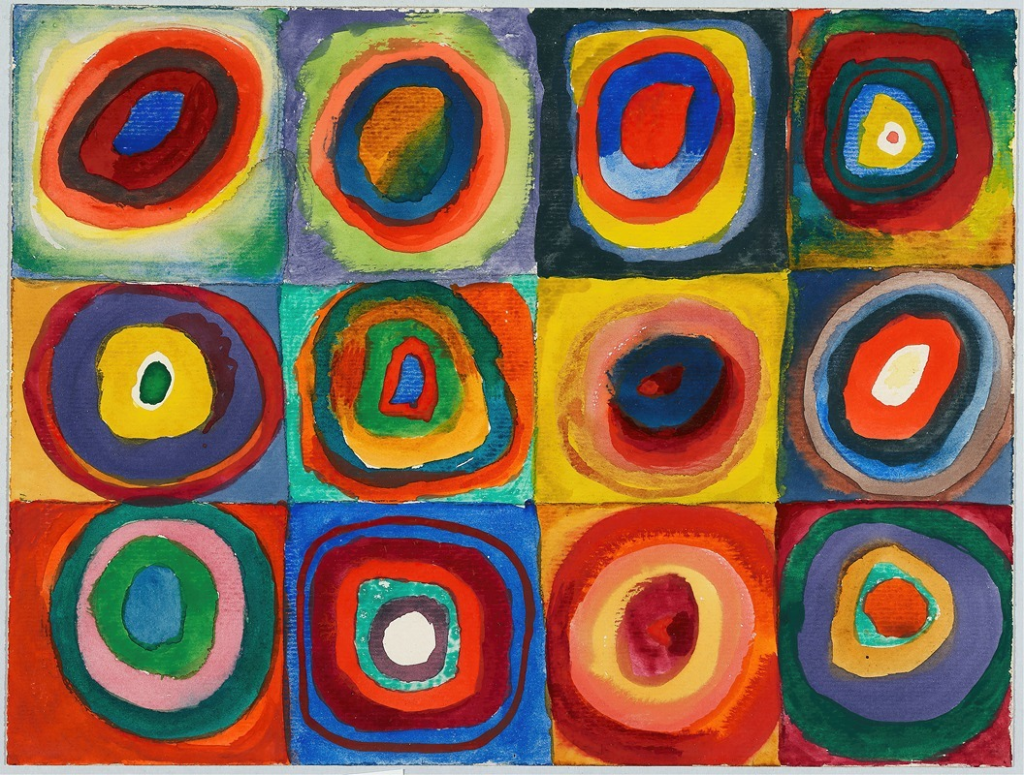
Wassily Kandinsky (1866–1944) was a Russian painter and art theorist widely considered to be one of the pioneers of abstract art. His groundbreaking work pushed the boundaries of traditional representation and sought to convey pure emotions and spiritual truths through color, shape, and form. Kandinsky believed that art should go beyond the material world, using abstraction to express inner experiences and universal truths.
Kandinsky’s art evolved through several phases, influenced by various styles including expressionism, fauvism, and his own unique interpretations. His works, such as Composition VII and Yellow-Red-Blue, emphasize dynamic compositions of geometric shapes and vivid colors, creating a visual language that resonated deeply with the viewer’s emotions. Kandinsky saw color as a spiritual force, assigning different emotions and meanings to various colors and shapes.
Through his theoretical writings, Kandinsky also helped shape the direction of modern art, emphasizing the importance of abstraction in conveying deeper, more personal truths. His legacy as a visionary of abstract expression continues to influence artists worldwide.
 artfullifejourney.art.blog
Leave a comment